
Last updated: November 24, 2026
Real estate investment in Turkey can be profitable in 2026 if you buy in the right district, at a fair price and with a clear goal. Prices are set in US dollars in most new projects, demand from local buyers is strong, and property can bring a residence permit or Turkish citizenship. The main disadvantages are high interest rates, exchange rate swings and lower foreign sales compared with the peak years, so the choice of location and developer matters more than ever.
Is real estate investment in Turkey profitable?
Returns come from two sources: rental income and capital growth. In Istanbul, well-located apartments typically earn around 5% to 7% a year in gross rent, more for short-term lets in tourist areas. Capital growth depends on the district: areas with new metro lines, urban renewal or major projects have grown fastest. Buyers who paid a fair price in the right location have usually done well; those who overpaid or chased quick resale gains on off-plan units have not.
Reasons investors buy property in Turkey in 2026
1. The market is driven by local demand
Turkish buyers account for the vast majority of sales. Local demand for housing, especially in Istanbul, keeps the market liquid even when foreign sales slow down.
2. Strong rental demand
Istanbul has more than 15 million residents, hundreds of thousands of university students and millions of tourists a year. Well-connected apartments rent quickly.
3. Prices that are still reasonable
Compared with other large global cities, Istanbul prices per square metre remain moderate, and many developers offer interest-free payment plans in US dollars.
4. Stability and investor confidence
Monetary tightening since 2023 has slowed inflation and stabilised the lira compared with previous years, which has improved planning for foreign investors.
Advantages of investing in Turkish property
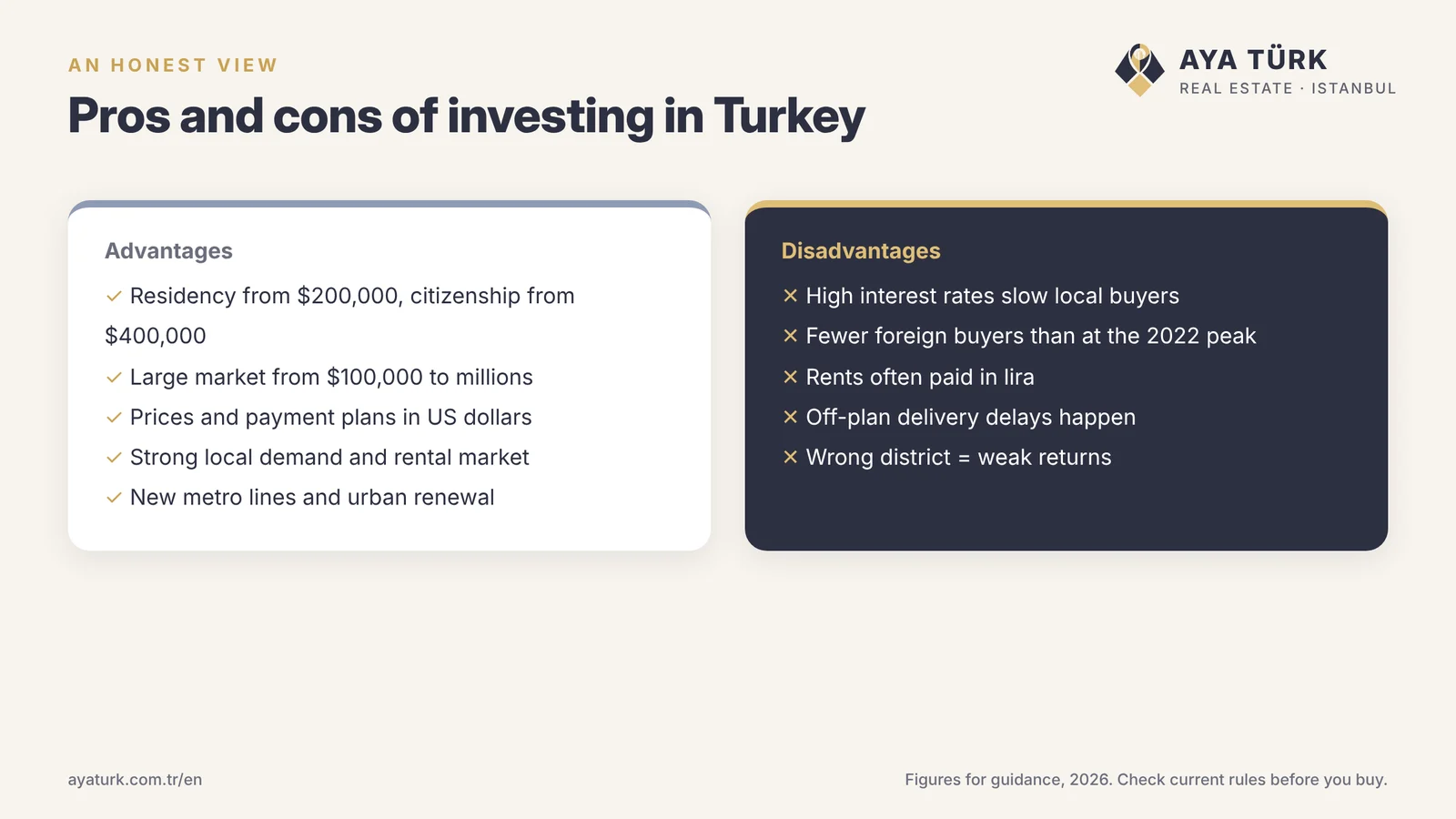
- Residency and citizenship: a residential property worth $200,000 or more in Istanbul supports a residence permit, and $400,000 or more qualifies for Turkish citizenship by investment.
- A large and varied market: apartments, villas, serviced apartments, shops and offices, from about $100,000 to several million dollars.
- Infrastructure and urban renewal: new metro lines, highways, the new Istanbul Airport and large urban renewal programmes keep raising values in the districts they reach.
- Clear legal ownership: foreigners can hold a full title deed in their own name.
Disadvantages of investing in Turkish property
- High interest rates: mortgages are expensive, which slows local demand for some price segments.
- Fewer foreign buyers than at the peak: sales to foreigners are lower than in 2022, which can lengthen resale times for units aimed only at foreigners.
- Exchange rate risk: rents are often paid in lira, so their dollar value moves with the exchange rate.
Common investment mistakes to avoid
Buying in the wrong district
A good apartment in a weak location rarely performs. Look for transport, schools, jobs and real rental demand, not only a low price.
Expecting quick profits from off-plan units
Off-plan prices are attractive, but delays happen and resale before delivery is hard. Choose developers with a delivery track record and keep a longer horizon.
Mixing goals
A unit that is ideal for short-term letting is rarely ideal for a family. Decide whether you are buying for income, growth, residency or living, and choose accordingly.
Paying above market value
Always compare prices per square metre in the same district and rely on an official valuation report, which is required for foreign buyers anyway.
Projects that fit different investment goals
These are examples from projects we market in Istanbul, with starting prices that change over time:
- Bizim Evler 10, Avcılar: ready family apartments by İhlas Yapı near the coast and a major university, from about $185,000.
- Referans Beylikdüzü: ready apartments in a planned coastal district, from about $180,000.
- Demir Life, Büyükçekmece: an entry-level option on the western edge of the city.
- Avrupa Konutları Çamlıvadi, Kağıthane: a central project in an urban renewal district, from about $315,000.
- Düşler Vadisi Riva, Beykoz: villas in a forest setting, all above the $400,000 citizenship threshold.
Ask us for the current price list of any of them.
Invest in Turkish real estate with Aya Türk
We match each investor with projects that fit their goal: rental income, growth, residency or citizenship. We check the developer, the price per square metre and the legal file before you commit, and we stay with you after the purchase for rental and resale.
Send us your budget and goal on WhatsApp, or contact our team.
Frequently asked questions
Is Turkey a good place to invest in property in 2026?
It can be, if you buy at a fair price in a district with real demand. Istanbul offers the most liquidity, rental demand and choice.
What rental yield can I expect in Istanbul?
Well-located apartments typically earn around 5% to 7% a year in gross rent, depending on the district and the type of letting.
Can foreigners invest in commercial property in Turkey?
Yes. Shops and offices can be bought by foreigners and also count towards the $400,000 citizenship investment.
What is the biggest risk for foreign investors?
Buying in the wrong location or paying above market value. A valuation report, a legal check and comparison with nearby prices reduce this risk.