
Last updated: November 24, 2026
Before you sign for an apartment in Turkey, check eight things: the apartment’s legal history, the type of title deed, the building and occupancy permits, whether the price is fair, how the money will be transferred, who pays the title deed fee, whether the address and size match the documents, and whether a tenant or the owner still lives there. Each one has cost buyers money when it was skipped.
8 checks before you sign
1. The apartment’s legal history
Ask for an up-to-date record from the Land Registry and check for mortgages, seizures, liens or court notes. A debt registered on the apartment can follow it to the new owner.
2. The type of title deed
A condominium title (kat mülkiyeti) is the safest. A construction servitude title (kat irtifakı) is normal for new buildings but means the occupancy permit is still pending. A shared title (hisseli tapu) needs extra care because other owners have rights too.
3. Building and occupancy permits
Make sure the building has a building permit and, if completed, an occupancy permit (iskan). Without iskan the building cannot get permanent utilities, and resale becomes harder.
4. A fair price
Compare the price per m² with similar apartments in the same district and rely on the official valuation report, which is required for foreign buyers. Be cautious of prices far below the market.
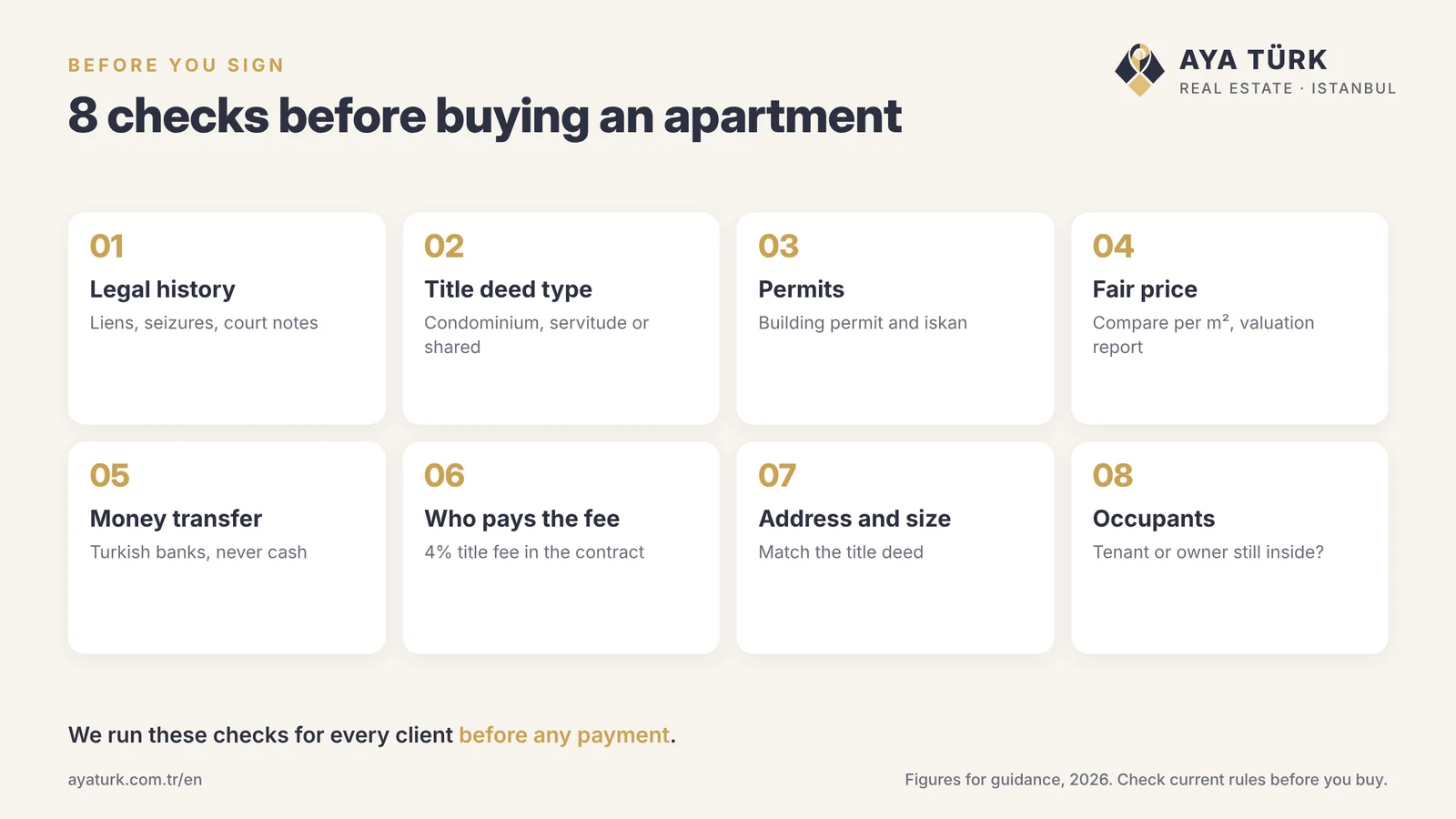
5. How the money is transferred
Pay through Turkish banks, never in cash, and keep the currency exchange certificate. Bank records protect you and are required for residency and citizenship applications.
6. Who pays the title deed fee
The 4% fee is split 2% and 2% by law, but developers often ask the buyer to pay it all. Write the agreement into the contract, together with the VAT status.
7. The address and the size
Check that the block, floor, unit number and area in the title deed match the apartment you viewed. Gross and net areas differ; ask for both.
8. Tenants or the owner still living there
If the apartment is occupied, agree the handover date in writing. In Turkey a sitting tenant’s lease continues after a sale, so you cannot simply ask them to leave.
How to choose the right apartment
The neighbourhood and location
Visit at different times of day. Check transport, schools, shops, hospitals and noise. A good apartment in the wrong street rarely performs well.
The apartment itself
Look at the layout, light, orientation, ceiling height, insulation and the quality of kitchens and bathrooms. Ask for the floor plan.
Earthquake safety
Prefer buildings constructed after the 2007 and 2018 earthquake regulations, and ask for the building’s structural report for older buildings. DASK earthquake insurance is compulsory.
The developer
For new projects, check the developer’s delivered projects, delays and after-sales service. Visit a completed project if you can.
Rental return and resale
Even if you plan to live in the apartment, check rents and resale demand in the area. A home that is easy to rent is also easier to sell.
Buy with confidence with Aya Türk
We run these checks for every client before any payment: Land Registry records, permits, price comparison and contract review with partner lawyers.
Send us the apartment you are considering on WhatsApp, or contact our team.
Frequently asked questions
What should I check before buying an apartment in Turkey?
The Land Registry record, the title deed type, the building and occupancy permits, the price per m², the payment route, the fees, the address and size, and whether the apartment is occupied.
Is it safe for foreigners to buy apartments in Turkey?
Yes, if you buy through the Land Registry with a title deed in your name, pay through banks and run the legal checks before paying.
Should I use a lawyer when buying in Turkey?
It is not mandatory, but a lawyer or a licensed agency with partner lawyers is strongly recommended to review the contract and the title records.
How do I know if an apartment is earthquake safe?
Check the construction year and permits, ask for structural reports for older buildings, and prefer projects built under the 2018 earthquake regulation.